//
PRODUCT BRIEF
//
FOREWORD
When I joined the development team, Qooco Talk had already been around for over 7 years. Initially built as a B2B eLearning solution for partner schools in Asia, the platform expanded into new markets and adopted additional business models over time.
The platform is a 'Swiss Army knife' for online / offline learning. Among other things, it is designed to:
[ 1 ] Get the students in line with school curriculum |
[ 2 ] Evaluate learning progress
|[ 3 ] Provide real-time analytics for parents and teachers |
[ 4 ] Assist school teachers with mundane tasks.
//
MY ROLE
I began as the sole designer on a product, where design decisions were mostly made by development and sales teams. After proving the value of design by improving key product metrics, I established and led design department that shaped Qooco Talk learning experience across iOS and Android platforms.
2016
2022
TIP
The screenshot above is a good representation of the amount of challenge platform re-design faced. The app spoke its own language, where too much info was given at once, with overcomplicated navigation and vague calls to action.
But all of this does not reflect the root of the problem. The purpose of the product felt unclear inside the company, and users could feel it too.
DESIGN CHALLENGE
LET THE CONTENT MATCH LEARNERS' NEEDS
When your product is used by variety of users for variety of things, finding where to start is an art form of its own. Firstly, I wanted to see if there's a consensus on current status of the product within the team.

STAGE I
THE DEFINE GAME
Re-designing a product with active users is never easy. Yet, 2016 was a year of significant transition for Qooco. The company tried to adopt new business models, expand to new markets and audiences. With this in mind, all teams were motivated to move forward.
Stakeholder interviews, requirement workshops, regular team meetings — I tried different instruments to build of unified vision of what we are trying to change and in which order.


STAGE II
TEST EVERYTHING IMPORTANT
As an Asia-based company, Qooco brought unique challenges to our Ukrainian-based design team. We quickly realized that some user behaviors could be culture-specific, and we couldn’t rely on our own assumptions when designing learning tools for children in another educational environment.
On our end, we ran regular guerrilla tests by inviting students from local private schools, so we could validate learning concepts through quick, iterative feedback cycles.
When an opportunity arose to visit Qooco's learning centers in Beijing, we seized it. During our time on the ground, we met with students across multiple tuition centers and tested a working demo that showcased our vision for interactive learning, the new grading model, and a redesigned navigation system. This allowed us to observe real users interacting with our prototype in their actual learning context—something no remote testing could replicate.

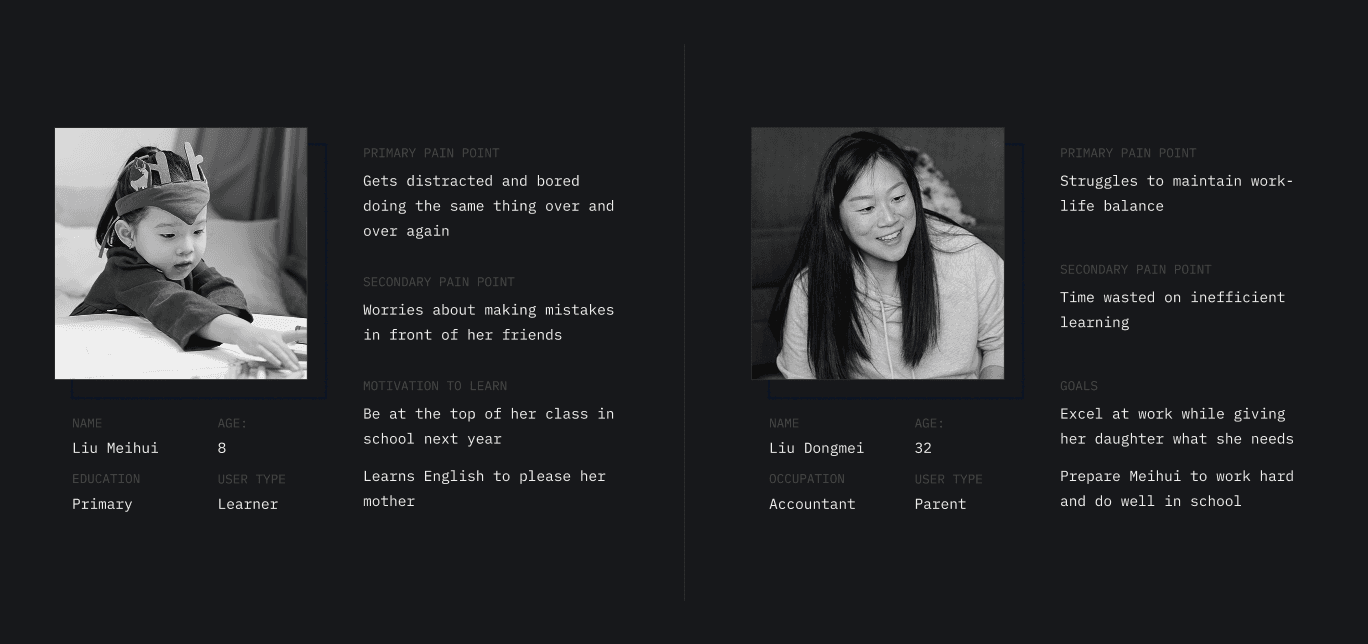
Beyond primary users, we interviewed parents, tuition center coaches, and school teachers to understand expectations, motivations, and pain points from every angle. Speaking directly with secondary users revealed nuances we had not previously considered: differences in pacing, parental involvement, reward structures, and classroom dynamics.
STAGE III
BABY STEPS TOWARDS THE GOAL
For live learning platform with an active user base the work is never 'finished'. Every insight reveals new opportunities: more personalized learning flows, more engaging exercise types, richer assessment tools, more accurate progress evaluation, etc.
Reflecting back on my time with Qooco, I believe the following to be my greatest accomplishments.
THE STRATEGY
Our effort to set a clear direction and take small deliberate steps toward it, validating each improvement with students, parents, and teachers, has resonated within the company. Different teams were united around one vision, which made product development easier.
THE VALUE OF DESIGN
By establishing and leading the design department, I made the value of design visible, tangible, and undeniable. The difference between how the product looked, felt, and behaved before design leadership—and after—spoke louder than any presentation could.
THE IMPACT
Due to change of legislation on educational services in China, I have not been able to see our strategy implemented 100%. Nevertheless, my time with Qooco was enough to see:
[ 1 ] increased number of A- and B-graded students among Qooco Talk users;
[ 2 ] increased parent and coach confidence thanks to more transparent progress tracking;
[ 3 ] faster iteration cycles enabled by a design-led approach to prototyping and validation.